
'...then preparing oneself for the long haul is also essential.' 'Identifying and holding onto values gives you strength to withstand the difficulties enroute.' 'Taking care of your physical, mental, and intellectual well-being gives you the strength to stay the path.'

Wholesale price inflation (WPI) softened to 0.13 per cent in September on easing in prices of food articles and manufactured items, government data showed on Tuesday. WPI-based inflation was 0.52 per cent in August and 1.91 per cent in September last year.
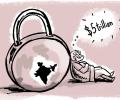
In order to achieve $5 trillion GDP by FY'25, India needs to spend about $1.4 trillion over this period on infrastructure, according to the Economic Survey. During financial years 2008-17, India pumped in about $1.1 trillion on infrastructure. However, the challenge is to step up infrastructure investment substantially, the Economic Survey 2021-22 said.

Equity markets this week would keenly track the upcoming GST Council meeting, macroeconomic data announcements and trading activity of foreign investors for further movement, analysts said. Moreover, developments related to tariff negotiations, global market trends and auto sales data would also drive investors' sentiment.

Credit quality of Indian corporate is expected to be stable in the second half of the current financial year (H2FY26), supported by easing monetary cycle, and declining inflation, coupled with income-tax relief and rationalisation of the goods and service tax (GST) rates, among others.
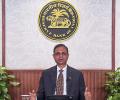
For the time being, the RBI is done with the cuts. A cut in October, which many are still predicting, is not certain. Of course, if growth nosedives, the script will be different, expects Tamal Bandyopadhyay.

India's military expenditure in 2024 was nearly nine times that of Pakistan's, according to a study released by the Stockholm International Peace Research Institute (SIPRI). India's spending reached USD 86.1 billion, while Pakistan spent USD 10.2 billion. China's military spending continued to rise, reaching USD 314 billion, accounting for 50% of all spending in Asia and Oceania.

The Asian Development Bank (ADB) on Wednesday lowered India's growth forecast for FY26 to 6.5 per cent from 6.7 per cent on account of trade uncertainty and higher US tariffs that are expected to impact exports and investment. Despite the downward revision from the April 2025 Asian Development Outlook (ADO), India remains one of the fastest-growing major economies in the world.

From the Sensex firms, Tata Motors jumped the most by 5.54 per cent, followed by Kotak Mahindra Bank, Trent, Sun Pharma, Axis Bank, and ICICI Bank. However, Bajaj Finance, State Bank of India, UltraTech Cement and Tata Steel were among the laggards.
Fitch Ratings on Thursday raised its forecast for India's economic growth to 6.3 per cent for current fiscal year 2023-24 from 6 per cent it had predicted previously. This is primarily because of a stronger outturn in the first quarter and near-term momentum. The growth forecast compares with 7.2 per cent GDP expansion in FY23. In the previous fiscal year (FY22), the economy had grown 9.1 per cent.

Billionaire Mukesh Ambani on Thursday termed the second-generation GST reforms as a big booster to consumption-driven growth while his firm promised to pass on the benefit of the cut in tax rates to consumers.
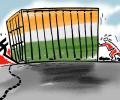
Merchandise exports to the US jumped 23.5 per cent year-on-year (Y-o-Y) to $8.3 billion in June, even as India's overall outbound shipments witnessed contraction during the month, according to the data released by the commerce department on Tuesday. The increase in outbound shipments to the US was largely driven by the rush among exporters to utilise America's pause on its plans to impose country-specific reciprocal tariffs.

Even if the Reserve Bank of India's Monetary Policy Committee decided to hold interest rates in the October meeting, it acknowledged the scope for further rate cuts while waiting for the impact of the past steps to play out.

India's current account deficit declined sharply to 1 per cent of the GDP or $8.3 billion in the second quarter of this financial year, mainly due to lower merchandise trade deficit and growth in services exports, according to a RBI data released on Tuesday. The current account deficit (CAD), which represents the difference between the total amount of money sent abroad and money received from overseas across the economy, was 3.8 per cent of GDP or $30.9 billion in the July-September quarter in 2022-23. CAD was $9.2 billion or 1.1 per cent of GDP in the first quarter (April-June) of the current financial year 2023-24.

Fitch Ratings on Thursday cut India's GDP growth estimate by 10 basis points to 6.4 per cent for the current fiscal, but retained the projections for the next financial year, on concerns over a 'severe' escalation in global trade war. "It is hard to predict US trade policy with any confidence. Massive policy uncertainty is hurting business investment prospects, equity price falls are reducing household wealth, and US exporters will be hit by retaliation," Fitch said in its special update to quarterly Global Economic Outlook (GEO).

The India Meteorological Department (IMD) forecasts the withdrawal of the southwest monsoon from northwest India around September 15. This year's monsoon covered the country earlier than usual, resulting in surplus rainfall and extreme weather events.

India's economic growth slowed to a 15-month low of 6.7 per cent in April-June 2024-25, mainly due to poor performance of the agriculture and services sectors, government data showed on Friday. The gross domestic product (GDP) expanded by 8.2 per cent in the April-June quarter of 2022-23. India, however, remained the fastest-growing major economy, as China posted a 4.7 per cent growth in April-June 2024.

'Make-in-India played a key role in India's effective action against terrorism during Operation Sindoor.'

'Revision of the base year for both CPI and GDP are long overdue.' 'The basic data that went into the 2011-2012 series were mainly from surveys done in 2011 or earlier.' 'We have since seen the emergence of new sectors like platform-based work and online marketing.' 'The employment surveys and the consumption surveys need to reflect these adequately.'

Amazon will invest more than Rs 2,000 crore (about $233 million) in India in 2025 as it strengthens its logistics and safety standards, said the ecommerce company on Thursday.

From mobilising protests to choosing the interim prime minister -- Discord, Bitchat became virtual control rooms, even as familiar platforms like TikTok, Reddit, Instagram, etc. played their part.

Whether Trump will actually press ahead with the oil sanctions remains unclear, since keeping Russian oil out of the world market risks high oil prices which could boomerang on the US economy and be damaging politically for Trump, points out Ambassador M K Bhadrakumar.

Even if no statistical jugglery is afoot, only to warn that the 'noise' in the numbers should be eliminated in order to hear the underlying music, without distortion, warns T N Ninan.

Vaccinating all citizens above the age of 18 years against COVID-19 will cost Rs 67,193 crore, of which states together will incur Rs 46,323 crore, India Ratings and Research (Ind-Ra) said on Thursday. As the second wave of COVID-19 sweeps the country with alarming speed and severity, the government has announced a liberalised and accelerated Phase 3 strategy of COVID-19 vaccination. Under this scheme, all persons above 18 years of age will be eligible to get COVID-19 vaccine doses from May 1.

India's GDP growth rate will rise to 7 per cent by 2026 compared to 4.6 per cent for China, S&P Global Ratings said on Tuesday. In a report titled 'China Slows India Grows', S&P said it expects Asia-Pacific's growth engine to shift from China to South and Southeast Asia. "We project China's GDP growth to slow to 4.6 per cent in 2024 (2023: 5.4 per cent), edge up to 4.8 per cent in 2025, and return to 4.6 per cent in 2026.
The World Bank on Wednesday lowered India's growth forecast for the current fiscal by 4 percentage points to 6.3 per cent amid global economic weakness and policy uncertainty. In its previous estimate, the World Bank had projected India's growth at 6.7 per cent for the fiscal year 2025-26.

The decision to hike US H-1B visa application fee to $100,000, trade talks and the GST rate cut will be the key drivers for stock market movement this week, analysts said.

Economies of Punjab, Andhra Pradesh, Madhya Pradesh, Uttarakhand and Haryana may have grown at a slower pace than the national economy during 2022-2023.

India will be the world's third-largest economy by 2028 as it becomes the world's most sought-after consumer market and gains share in global output, driven by macro stability influenced policy and better infrastructure, Morgan Stanley said. From a $3.5 trillion economy in 2023, the Indian economy is projected to expand to $4.7 trillion in 2026, which will make it the fourth largest in the world behind the US, China and Germany.
Fitch Ratings on Monday said India's pace of debt reduction is gradual, leaving room for a downside risk to sovereign rating in the eventuality of a significant economic shock. However, the rating agency expressed confidence in India's ability to stick to its medium-term fiscal framework, which aims to reduce debt and bring it on a downward trajectory over time.

These changes certainly bring India's GST a lot closer to what an ideal GST would look like, points out Karan Bhasin.

India's manufacturing sector growth fell to a three-month low in May, restricted by inflationary pressures, softer demand and heightened geopolitical conditions, a monthly survey said on Monday. The seasonally adjusted HSBC India Manufacturing Purchasing Managers' Index (PMI) fell from 58.2 in April to 57.6 in May, highlighting the weakest improvement in operating conditions since February.

Pakistan on Tuesday increased its defence budget by 20 per cent, allocating PRs. 2,550 billion ($9 billion) for the fiscal year 2025-26, amid tensions with India.

N Chandrasekaran, chairman of Tata Consumer Products, has said in the company's annual report for FY25 that India remains one of the bright spots of economic growth amid a volatile global environment. He said India's long-term growth was underpinned by strong demographic and economic fundamentals as well as structural reforms.

India is well-positioned to deal with the negative effects of US tariffs and global trade disruptions as domestic growth drivers and low dependence on exports anchor the economy, Moody's Ratings said on Wednesday.
The Indian economy will grow at around 6.5 per cent in the current fiscal, notwithstanding high crude oil prices and increased uncertainty due climate changes, NITI Aayog member Arvind Virmani said on Thursday. Virmani also asserted that the gross household savings ratio in India has consistently gone up. In an interview with PTI, he said: "My growth projection (of India's GDP growth) is 6.5 per cent plus minus 0.5 per cent... because my experience is that the fluctuations in global GDP more or less has balanced out for us, assuming normal changes."

The Centre's fiscal deficit stood at 17.9 per cent of the full-year target at the end of June, according to data released by the Controller General of Accounts (CGA) on Thursday. It was at 8.4 per cent of Budget Estimates (BE) of 2024-25 in the first three months of the previous financial year.

'I do believe there will be a resolution in the next couple of months on the penal tariff and hopefully on the reciprocal tariff also.'

Finance Minister Nirmala Sitharaman will present her 8th straight Budget and all eyes will be on the much-expected tax relief for the middle class. Sitharaman had in her first Budget in 2019 replaced the leather briefcase -- which had been in use for decades for carrying Budget documents -- with a traditional 'bahi-khata' wrapped in red cloth.

India has to fill in all the critical gaps in missiles, ammunition, sensors and stockpile in the fastest possible manner, focusing on the critical instruments that worked this time, asserts Shekhar Gupta.
